Business leadership requires vision, discipline, adaptability, and the ability to make important decisions under pressure. Successful executives often develop different approaches to these responsibilities based on their industries, experiences, and professional goals. Some leaders focus on financial markets and investment strategies, while others concentrate on public services, infrastructure, and customer safety. Although their responsibilities differ, both groups influence organizations, employees, customers, and the broader economy.
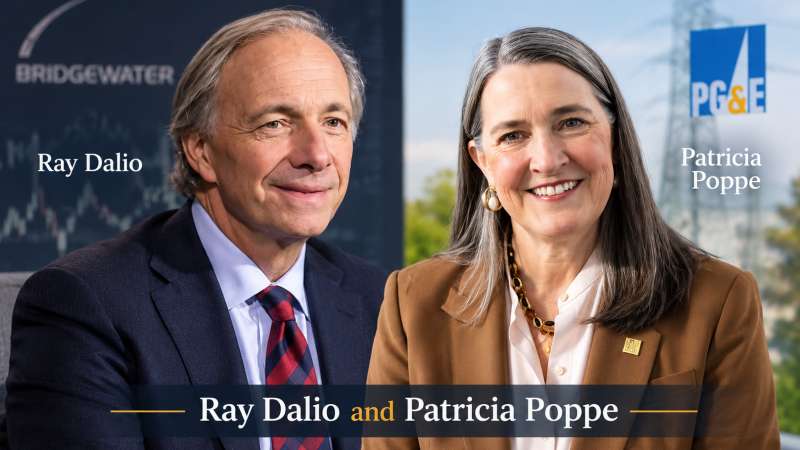
Ray Dalio and Patricia Poppe represent two distinctive approaches to modern corporate leadership. Dalio built his reputation in global finance by developing investment strategies, studying economic cycles, and promoting principles-based decision-making. In contrast, Patricia “Patti” Poppe established herself as a prominent energy-sector executive through her work in manufacturing, utility management, and large-scale organizational transformation.
Their professional journeys demonstrate how leaders can achieve meaningful results in different business environments. Moreover, their experiences provide valuable lessons about risk management, accountability, communication, innovation, and organizational culture.
This article explores their backgrounds, careers, leadership philosophies, achievements, challenges, and lasting influence. It also explains how their approaches compare and what business owners, managers, and aspiring professionals can learn from their experiences.
Who Is Ray Dalio?
Ray Dalio is an American investor, entrepreneur, and author best known for founding Bridgewater Associates, a major global investment management firm. He developed a reputation for analyzing economic trends, studying financial cycles, and creating systematic approaches to investment decisions.
Dalio was born on August 8, 1949, in Queens, New York. His early interest in financial markets began when he was young. As a teenager, he purchased shares in Northeast Airlines, an experience that helped introduce him to investing and market behavior.
However, his early experiences also taught him that financial markets rarely follow simple patterns. Prices can change unexpectedly, and investors must consider economic conditions, business performance, and human behavior when making decisions.
Dalio later studied finance and earned an MBA from Harvard Business School. After completing his education, he pursued opportunities in financial services and gradually developed the ideas that would shape his career.
The Founding of Bridgewater Associates
Dalio founded Bridgewater Associates in 1975. He initially operated the business from a small apartment, providing investment advice and financial research to clients.
At first, the company concentrated on economic analysis, currency movements, and financial market trends. Over time, Dalio expanded its activities and developed a more systematic investment approach.
Bridgewater eventually became one of the world’s most influential hedge fund firms. Its growth reflected a combination of institutional investment relationships, economic research, quantitative analysis, and structured decision-making.
Furthermore, Dalio encouraged employees to examine assumptions and challenge established opinions. He believed that organizations could improve their decisions by welcoming disagreement and evaluating ideas according to evidence rather than seniority.
As Bridgewater expanded, it became associated with sophisticated investment strategies and extensive internal documentation of management principles.
Dalio gradually transferred leadership responsibilities to other executives over several years. His departure from the firm’s leadership and his later exit from his ownership stake marked an important transition in his professional life.
Ray Dalio’s Investment Philosophy
Dalio’s investment philosophy emphasizes understanding how economies function and how financial markets respond to changing conditions. Rather than relying entirely on intuition, he promotes systematic research, historical analysis, and disciplined risk management.
One important concept associated with his work is risk parity. This investment approach focuses on balancing the contributions different assets make to the overall risk of a portfolio. Depending on the strategy, investors may use leverage to adjust those contributions.
Nevertheless, risk parity does not eliminate investment risk or guarantee positive returns. Market conditions, interest rates, inflation, and correlations between assets can change, so investors must continue evaluating their portfolios.
Dalio also emphasizes diversification. By distributing investments across different asset classes and economic environments, investors can reduce their dependence on a single market outcome. However, diversification cannot prevent every loss, particularly during periods when several markets decline together.
Another important element of his philosophy involves studying economic cycles. Dalio examines the relationships between debt, productivity, inflation, interest rates, and monetary policy. These relationships can help investors develop scenarios for possible economic developments.
Ultimately, his approach combines research, risk assessment, and a willingness to revise assumptions when new evidence appears.
Who Is Patricia “Patti” Poppe?
Patricia “Patti” Poppe is an American business executive known for leading major companies in the energy and utility sectors. She has developed extensive experience in manufacturing operations, electric utilities, organizational transformation, and infrastructure management.
Poppe became widely recognized for her leadership at CMS Energy and Consumers Energy before taking charge of Pacific Gas and Electric Company, commonly known as PG&E.
Her career demonstrates how operational experience can prepare executives to manage complex organizations that provide essential services to millions of customers.
Unlike investment managers, utility executives must balance financial performance with reliability, regulatory requirements, environmental responsibilities, employee safety, and public expectations. These demands require long-term planning and careful coordination across many departments.
Early Career and Professional Development
Poppe developed her professional foundation through education and hands-on experience in manufacturing and energy operations. She earned a degree in industrial engineering from Purdue University and later completed an MBA at the University of Michigan.
Her engineering background helped her understand operational systems, production processes, and technical problem-solving. Meanwhile, her business education provided additional knowledge of finance, organizational strategy, and management.
Before becoming a chief executive, Poppe held various positions at General Motors. She gained experience in manufacturing operations and leadership, which helped her understand how large organizations manage people, equipment, budgets, and performance expectations.
She subsequently joined the energy industry and advanced through leadership roles at CMS Energy and Consumers Energy.
These positions gave her experience in electricity generation, customer service, utility operations, and long-term infrastructure planning. As a result, she developed a management perspective that connects technical performance with employee engagement and customer needs.
Leadership at CMS Energy and Consumers Energy
Poppe became CEO of CMS Energy and Consumers Energy in 2016. During her tenure, she focused on organizational transformation, customer experience, and improvements to energy infrastructure.
Utility companies face increasing pressure to modernize aging equipment, improve reliability, and respond to changing environmental expectations. Therefore, their leaders must balance immediate operational demands with investments that may take years to deliver benefits.
Poppe emphasized customer-focused service and employee involvement. She also supported efforts to modernize energy systems and improve the company’s ability to respond to operational challenges.
Her leadership at CMS Energy strengthened her reputation as an executive capable of managing complex infrastructure organizations. It also prepared her for a role involving even greater public scrutiny and safety responsibilities.
Becoming CEO of PG&E
Poppe became CEO of Pacific Gas and Electric Company in January 2021. She assumed leadership during a difficult period for the California utility, which faced significant challenges involving wildfire liabilities, infrastructure safety, regulatory oversight, and public trust.
Wildfires in California had intensified concerns about the relationship between utility equipment, vegetation management, extreme weather, and fire risk. Consequently, PG&E needed to demonstrate meaningful progress in safety, reliability, and accountability.
Poppe’s responsibilities extended beyond ordinary corporate performance. She had to work with employees, regulators, policymakers, customers, emergency responders, and community representatives.
Her leadership agenda emphasized infrastructure improvements, wildfire risk reduction, operational discipline, and organizational culture. These priorities required substantial investment and coordination across a large service territory.
However, utility transformation cannot happen overnight. Infrastructure projects involve engineering assessments, regulatory approvals, construction schedules, and financial planning. Therefore, executives must measure progress over time while maintaining attention to immediate safety concerns.
Poppe’s role illustrates the demanding nature of leadership in an industry where operational decisions can have serious consequences for public safety and community well-being.
Ray Dalio and Patricia Poppe: Comparing Leadership Styles
Although these executives work in different industries, their careers offer useful comparisons. Dalio concentrates on investment decisions and economic uncertainty, while Poppe focuses on utility operations, public safety, and organizational transformation.
Their leadership styles reflect the different challenges they face.
1. Data-Driven Decision-Making
Dalio emphasizes research, historical patterns, and systematic evaluation. He encourages people to identify weaknesses in their assumptions and consider evidence before making decisions.
This approach can help investment teams evaluate complex markets and understand potential risks. However, financial models remain dependent on assumptions, and historical patterns cannot predict every future event.
Poppe also relies on data, particularly when evaluating equipment performance, operational reliability, customer needs, and infrastructure risks. Utility executives must use technical information to prioritize investments and monitor safety improvements.
The key difference lies in the decisions they make. Dalio evaluates financial opportunities and portfolio risks, whereas Poppe oversees systems that deliver essential energy services.
2. Transparency and Accountability
Dalio became known for promoting radical transparency within Bridgewater. His philosophy encourages employees to communicate openly, challenge ideas, and identify mistakes.
He also developed the concept of an idea meritocracy, in which decision-makers evaluate ideas according to their quality and supporting evidence rather than simply accepting the views of senior executives.
Poppe’s leadership responsibilities require accountability across operations, safety procedures, customer service, and regulatory compliance. Her organization must communicate with stakeholders and demonstrate progress on major commitments.
Although the methods differ, both approaches highlight the importance of clear expectations, honest feedback, and responsibility for results.
3. Empathy and People-Centered Management
Dalio’s management philosophy often emphasizes direct feedback, rigorous debate, and continuous improvement. Some employees may appreciate this environment, while others may find its intensity challenging.
Poppe, meanwhile, has promoted a people-focused leadership philosophy frequently described as “leading with love.” This approach emphasizes empathy, employee engagement, customer needs, and the human consequences of business decisions.
For Poppe, employee involvement matters because utility operations depend on people who maintain equipment, respond to emergencies, and serve customers. A strong safety culture requires workers to identify hazards and communicate concerns without hesitation.
Neither approach automatically suits every organization. Effective leaders must consider their employees, industry requirements, and organizational culture when deciding how to communicate expectations.
4. Managing Risk and Uncertainty
Risk management sits at the center of both careers, although the risks differ significantly.
Dalio evaluates market volatility, debt cycles, economic developments, and portfolio exposure. His approach seeks to prepare investors for different possible economic environments rather than depend on a single forecast.
Poppe manages operational, environmental, financial, and public safety risks. At PG&E, wildfire prevention and infrastructure reliability represent particularly important priorities.
Financial losses and utility failures can both have serious consequences, but they require different controls. Investors may diversify portfolios, while utility companies must maintain equipment, assess hazards, follow safety standards, and coordinate emergency responses.
Their experiences demonstrate that effective risk management begins with identifying potential problems and preparing practical responses before a crisis develops.
Major Challenges in Their Careers
Every executive encounters challenges, but the nature of those challenges depends on the organization and its responsibilities.
Challenges Faced by Ray Dalio
Dalio built Bridgewater during periods of changing interest rates, inflation, economic growth, and financial market volatility. Investment managers must make decisions without knowing exactly how markets will behave.
They also face pressure to maintain client confidence, manage losses, and adapt to changing economic conditions.
In addition, Dalio’s emphasis on radical transparency generated discussion about workplace culture. Direct feedback can support learning, but organizations must implement it thoughtfully to maintain respect, trust, and productive collaboration.
His experience shows that successful investment management requires continuous learning rather than unquestioning confidence in one strategy.
Challenges Faced by Patricia Poppe
Poppe took charge of PG&E amid significant scrutiny over wildfire safety, corporate accountability, and infrastructure performance.
Addressing these challenges requires more than public statements. Utility leaders must support engineering improvements, establish clear responsibilities, monitor implementation, and cooperate with regulators and communities.
Furthermore, infrastructure investments can create difficult financial decisions. Companies must fund essential improvements while considering affordability, reliability, and long-term customer needs.
Poppe’s position therefore requires balancing competing priorities without losing sight of public safety.
Her experience highlights the importance of sustained execution, transparent communication, and measurable improvements when an organization seeks to rebuild trust.
What Business Leaders Can Learn From Their Experiences
The professional journeys of these executives provide several practical lessons for entrepreneurs, managers, and aspiring leaders.
Build a Clear Decision-Making Framework
Leaders should establish consistent processes for evaluating opportunities, identifying risks, and comparing alternatives. A structured framework reduces impulsive decisions and helps teams understand why particular actions make sense.
However, managers should remain flexible enough to adjust their methods when circumstances change.
Encourage Honest Communication
Employees often recognize operational problems before senior management does. Therefore, leaders should create channels that allow workers to raise concerns, challenge assumptions, and share useful ideas.
At the same time, open communication must include respect and constructive feedback. Criticism should improve decisions rather than discourage employees from participating.
Put Risk Management First
Organizations should identify their most significant risks and develop practical ways to reduce them.
For an investment firm, this may involve diversification, scenario analysis, and monitoring portfolio exposure. For a utility company, it may require equipment inspections, emergency planning, vegetation management, and rigorous safety procedures.
In either case, leaders should review their risk controls regularly instead of assuming that previous success guarantees future safety.
Combine Technical Knowledge With Human Understanding
Technical expertise helps executives understand complex problems, but leadership also requires communication, empathy, and the ability to motivate people.
Managers should explain goals clearly, listen to employees, and recognize how organizational decisions affect customers and communities.
By combining analytical thinking with human understanding, leaders can make better decisions and build stronger teams.
Measure Progress Over Time
Major transformations rarely produce immediate results. Leaders should establish realistic milestones, monitor performance, and communicate progress honestly.
They should also recognize setbacks and adjust their plans when evidence shows that a different approach would work better.
The Broader Impact of Their Leadership
Dalio’s influence extends across investment management, economic commentary, and leadership education. His books and public discussions have introduced many readers to principles-based decision-making, financial cycles, and the importance of examining assumptions.
His work has also encouraged debate about the effectiveness of quantitative investment strategies, workplace transparency, and the limitations of economic forecasting.
Poppe’s influence centers on the energy sector and the management of essential public infrastructure. Her career demonstrates how executives can bring operational experience and customer-focused thinking to organizations facing complex safety and reliability challenges.
The energy industry continues to evolve as companies respond to electrification, changing demand, extreme weather, renewable energy development, and grid modernization. These trends require leaders who can coordinate technical improvements with financial planning and public accountability.
Although their contributions differ, both careers demonstrate the importance of preparing organizations for uncertainty and making decisions with long-term consequences in mind.
Frequently Asked Questions
1. Who is Ray Dalio?
Ray Dalio is an American investor, author, and entrepreneur who founded Bridgewater Associates in 1975. He became known for global macro investing, economic analysis, risk management, and his book Principles: Life and Work.
2. Who is Patricia “Patti” Poppe?
Patricia Poppe is an American corporate executive known for leading companies in the energy and utility industries. She previously led CMS Energy and Consumers Energy before becoming CEO of PG&E in January 2021.
3. Do Ray Dalio and Patricia Poppe work together?
No publicly established direct business partnership connects them. They have led organizations in different industries, with Dalio focusing on investment management and Poppe concentrating on energy and utility operations.
4. What is Ray Dalio’s leadership philosophy?
Dalio emphasizes radical transparency, evidence-based decision-making, systematic risk management, and the idea meritocracy. He encourages people to challenge assumptions and evaluate ideas according to their merits.
5. What is Patricia Poppe’s leadership philosophy?
Poppe emphasizes customer service, employee engagement, operational accountability, and empathy. Her “leading with love” approach highlights the importance of understanding people while pursuing organizational goals.
6. What can entrepreneurs learn from these executives?
Entrepreneurs can learn to establish clear decision-making processes, encourage honest communication, manage risks, invest in employees, and measure progress consistently. They can also recognize that leadership methods should reflect the organization’s needs and responsibilities.
Conclusion
The careers of these two executives demonstrate that effective leadership can take many forms. Ray Dalio built an influential investment management business through economic analysis, systematic decision-making, and a principles-based management philosophy. Patricia Poppe developed her reputation through operational leadership, energy-sector experience, and efforts to improve utility performance and safety.
Their professional experiences offer different but complementary lessons. Dalio’s work highlights the value of disciplined thinking, diversification, and challenging assumptions. Poppe’s career emphasizes public accountability, infrastructure investment, employee engagement, and the human consequences of operational decisions.
Ultimately, successful leadership requires more than a strong personality or an impressive professional record. It demands clear goals, sound judgment, continuous learning, and the ability to respond responsibly to changing circumstances.
By studying their distinct approaches, business professionals can develop a broader understanding of risk, organizational culture, and strategic decision-making. These lessons can help leaders build resilient organizations, support their teams, and create lasting value for the people and communities they serve.
For more info visit Thenewsmedium